

The 1980 referendum didn’t empty Montreal. It was the socio-economic program.
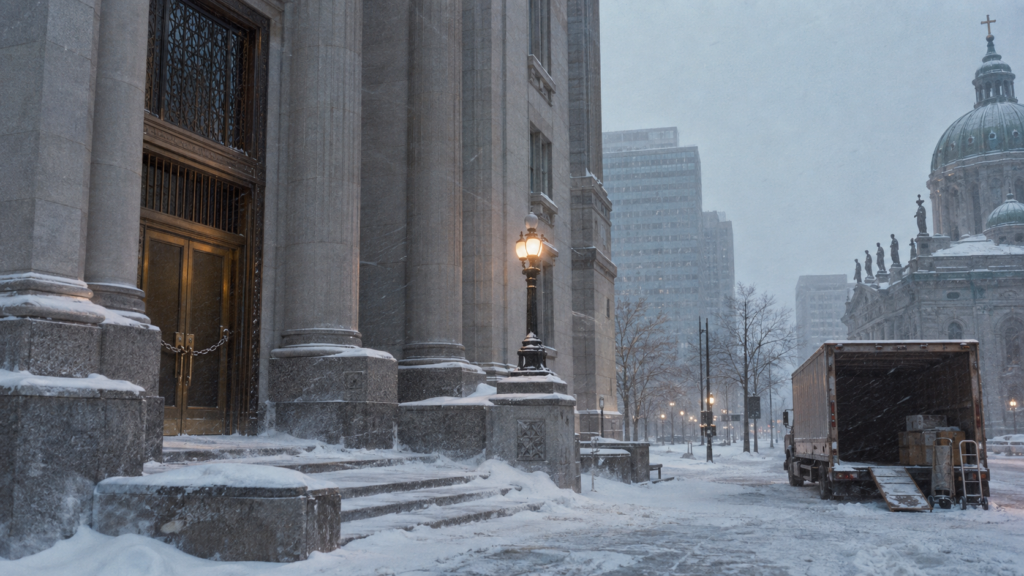
On Epiphany (January 6), 1978, Sun Life Assurance announced that it was moving its swanky head office to rented space in Toronto. Someone spray-painted “Bon débarras,” good riddance, on their Dominion Square massive granite building in Montreal. Montreal Exchange brokers called the day Black Friday. The 1980 referendum on sovereignty-association was still over two years away.
Keep that date in mind.
On September 2 (2026), my good friend and former Alberta premier Jason Kenney posted a short lecture to the Alberta separatists. He says they want to copy Quebec’s separatist politics. Do they really want to go from richest province to poorest large province, from “have” to “have not,” from the lowest taxes in Canada to the highest in North America, and to relive the outflow of money, businesses and people that “separatist uncertainty and endless squabbling” set off in Quebec? (See tweet image below).
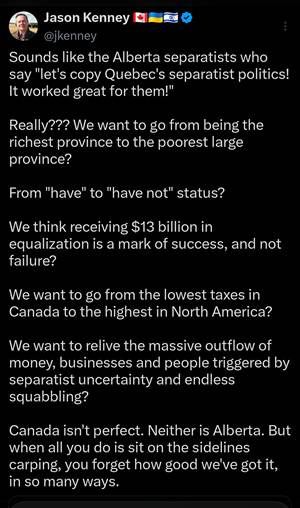
Four claims in that post deserve a close look because the former premier is a serious Albertan and the October 19 referendum is a serious vote.
I have insight to share into some of these things, not only because I studied them formally but because I experienced them firsthand: I grew up in Quebec and went through high school, college, and university in Montreal between 1979 and 1990. I lived a good portion of the story the former premier is telling, and for the benefit of Albertans, we must get it right.
First: who is copying whom?
Search the referendum campaign, the Alberta Prosperity Project’s materials, or the Free Alberta Strategy that Rob Anderson, Barry Cooper and Derek From published on September 28, 2021, and you will find Quebec cited constantly. What you will not find is anyone proposing Quebec’s economic model.
Nobody in the Yes camp has asked for a 25.75 per cent top provincial income tax rate, a 9.975 per cent sales tax, Hydro-Québec-style rate suppression, or a labour code that forbids replacement workers. Jason first mentions Quebec politics but then swiftly veers toward economics, suggesting that politics begets economics or that autonomist Albertans want to copy Quebec’s economics.
Many Albertans admire Quebec’s institutional strengths: a provincial pension plan since 1966, a provincial police force since 1870, a provincial revenue agency, a permanent presence in the Supreme Court, and a seat at the federal table that Ottawa never dares to leave empty. Anderson said as much when he launched the strategy group in September 2021: “Basically we want what Quebec already has.” He clearly means institutions, not their economic model.
Those are exactly the instruments the Fair Deal Panel recommended studying in May 2020. The panel reported to Premier Jason Kenney, who commissioned it. The 2021 referendum on removing equalization from the Constitution was his too.
Some of the toolkit was assembled by the man now warning about the toolbox.
Second: Quebec was never a “have” province to begin with
Equalization pays provinces whose per-capita fiscal capacity falls below the ten-province average. Alberta’s capacity is the highest in the country, which is why economists on every side agree that no formula could ever make Alberta a recipient.
Quebec’s status is the opposite kind of constant. The program itself began in 1957, under Maurice Duplessis’ Union Nationale [corrected] government, seven years before the Quiet Revolution reached full stride and nineteen years before the Parti Québécois first won an election. Quebec drew a cheque in year one. It kept drawing one through Lévesque and Parizeau’s separatist governments, through Bourassa’s federalist ones, through Lucien Bouchard in the 1995 referendum, through Charest and Couillard’s austerity, and it draws one today under the Coalition Avenir Québec, a government considerably friendlier to markets than Lévesque’s ever was. Sixty-nine years, every government, every ideology, one status: Quebec has taken in roughly 51 to 52 per cent of every equalization dollar Ottawa has ever paid out.
Kenney’s tweet asks whether separatists want to go “from have to have not.” The question assumes a status Quebec has never held. There is no version of Quebec, nationalist or federalist, socialist or entrepreneurial, that has ever paid into equalization rather than drawn from it. “Have not” is not a destination Quebec risks reaching. It is the only address Quebec has ever had.
Meanwhile, Albertans sent Ottawa $321.9 billion more than they got back between 2007-08 and 2026-27, by the Fraser Institute’s June 2026 projection, roughly $20 billion a year on Trevor Tombe’s long-run estimate. While some complain that Alberta pays, the core complaint about Quebec is that the same province drawing the largest equalization cheque in the country has, for a decade, blocked Alberta’s energy from reaching the market that would let Alberta keep paying it. Quebec killed the Energy East pipeline in 2017 before a single barrel moved through it, and killed the Énergie Saguenay LNG terminal in 2021 after Western Canadian gas had already been engineered into the project, a decision Ottawa confirmed the following year. Both would have carried Alberta and British Columbia product to tidewater. Both died in Quebec. A province can be a permanent net recipient and a permanent gatekeeper at the same time. Quebec manages both.
Haultain Research is a reader-supported publication. To receive new posts and support our work, consider becoming a free or paid subscriber. You may also support us by sharing our work with like-minded friends and family, or making a modest donation at www.haultain.org
Third: secession does not carry a price tag by itself
Jason’s tweet does not directly claim that separation would impoverish Alberta. Its logic is narrower and, in his other public statements, more explicit: the wanting itself is the danger, whatever the outcome of any vote. He has made that case at length elsewhere. In The Republic of Alberta, the 2026 book draws heavily on his own commentary, warning that a referendum campaign could set off what he calls a “non-violent civil war dynamic,” rupturing families, marriages and community organizations before a single ballot is counted.
On one front, the concern is not hypothetical. Chief Clifford Poucette and other First Nations leaders claim that separatist talk, independent of any vote ever being held, already unsettles treaty obligations that predate the province itself. Justice Colin Feasby ruled in December 2025 that a proposed referendum question was unconstitutional because it failed to address Treaty 6, 7 and 8 rights, and a second judge quashed a revised petition on similar grounds in 2026; an appeal contesting these claims is still before the courts.
Those are real complications, and they deserve to be argued on their own terms, not folded into a tweet about Quebec’s tax rates. But Jason’s own logic cuts both ways. If merely wanting to leave produces the disorder he describes, that disorder cannot be blamed on any particular act of leaving, since by his account it arrives before the leaving does. Quebecers wanted to leave, loudly and repeatedly, for two decades before 1995 and have not entirely stopped wanting to since.
The disorder Jason attributes to that wanting would then have to explain not just 1976 to 1981 but every year afterward, including the years Quebec’s finances improved. It does not. The wanting was a constant. The outcomes were not. What changed the outcomes was what governments did while people kept wanting. That is the distinction Jason’s tweet erases, and it is the subject of the rest of this piece.
Jason’s implicit rule is that leaving makes you poor. History declines to cooperate.
Norway left its union with Sweden in 1905 and became one of the richest countries on earth. Singapore left Malaysia in 1965 with no hinterland and no water, and within a generation had outstripped the country that expelled it. Slovakia walked out of Czechoslovakia in 1993 as the poorer half; it now sits inside the European Union and the euro area with a per-capita income that would have seemed fanciful to anyone in Bratislava that year. Estonia, Latvia and Lithuania left the Soviet Union in 1991 and joined the club of high-income economies. Slovenia did the same from Yugoslavia. Each case had its own conditions, and none is Alberta. But the pattern is plain: what happened afterward depended on what the new state chose to do, not on the act of choosing.
And here is an important detail Kenney’s example quietly omits. Quebec never seceded. It lost two referendums and stayed. But 50 years later, it is still a recipient, all while comfortably nestled inside the Canadian federation. Whatever economic damage Quebec suffered or continued to suffer after 1976, secession didn’t cause it. Something else did, and its presence in Canada has not magically fixed and turned it into a have province. So there is that.
Fourth: what emptied Montreal
The former premier is right about one thing. Uncertainty about the new Parti Québécois government did drive capital and people out of Quebec. Between 1976 and 1981, Statistics Canada counts 151,000 anglophones leaving Quebec, with a net loss of 123,000 people in five years, the worst on record. Head offices followed or led.
But look at what the government of René Lévesque did in its first 18 months, before any referendum date had been set, and before a single Quebecer had cast a ballot on sovereignty.
Language came first. The Charter of the French Language became law in August 1977, and it reached well past the schoolyard: French became the mandatory language of the workplace, francization certificates were required of every larger employer, and English commercial signage came under new restrictions, imposing crushing costs on business.
Labour came next, and it came from a real wound. Twenty months of the United Aircraft strike in Longueuil had turned violent, and when Bill 45 outlawed the use of replacement workers during a strike or lockout, the first such ban anywhere in North America, Labour Minister Pierre-Marc Johnson told the National Assembly why: “where there are scabs, there is violence.” The government matched the new labour code with a public monopoly on automobile insurance for bodily injury and, within its first two years, moved to buy an ailing asbestos producer through a new Société nationale de l’amiante, paying well for an industry already collapsing under cancer litigation.
The state’s reach extended into finance itself. Jacques Parizeau, the finance minister, filled the Caisse de dépôt et placement, the pension fund of every working Quebecer, with political appointees within months of taking office, a politicization one later study would call the beginning of “state capitalism” in the province.
And the government reached into wages and into its own survival. It raised the minimum wage to $3.27 an hour on January 1, 1978, and indexed it to stay there. Ontario, the province absorbing Quebec’s fleeing head offices, was still paying $2.65 an hour that same day, 23 per cent less. Quebec’s unemployment rate, a contemporary account in Reason magazine noted in mid-1978, had climbed past 11 per cent.
Parizeau’s second budget, in 1978, raised taxes on incomes above $30,000, and he met the backlash with a shrug he later made famous: “the revolt of the rich.” A new election-financing law capped private political contributions at levels that made building a rival party very hard indeed.
Lévesque had promised all of this as far back as 1976, in a phrase he used often enough that it became his own: a “préjugé favourable aux travailleurs,” a built-in bias toward the worker. His finance minister, an economic nationalist who never met an intervention he distrusted, ran deficits until 1984 and later, in the words of political scientist Brian Tanguay, “purchased social peace by granting the unions a number of generous concessions, especially with respect to maternity leave and job security.” A government of professors was building a socialistic state, and it said so loudly.
That, and not the referendum alone, is what Sun Life was leaving when it made its announcement in January 1978. Lévesque did not announce the referendum question until December 1979. The head offices had already gone.
A shift that started long before the PQ
Setting the record straight requires one more historical acknowledgement. Toronto did not become Canada’s financial capital because of Bill 101. The Toronto Stock Exchange had already overtaken Montreal’s in trading volume in the 1930s, and by 1950 Toronto was the ascendant centre for mining and corporate finance while Montreal’s relative weight had been sliding for two decades.
The Parti Québécois did not start that shift. In its first eighteen months, it gave businesses already leaning toward Toronto a decisive reason to stop delaying the move, and it did so with the specific instruments listed above, not with a plebiscite that had not yet been called.
Why the federal version won
Ottawa had no interest in that reading. Pierre Trudeau’s government needed autonomy-seeking Quebecers who were not separatists to see the PQ as the cause of their troubles, and “separatism scares business” did that work far more efficiently than “your government’s labour code scares business.” The second argument would have invited Quebecers to ask why Trudeau’s own labour code, and Ottawa’s own tax rates, were so close to Quebec’s. The unity narrative required that the exodus be filed under nationalism rather than under economics. It was, and it has stayed there for 48 years, long enough for a former Alberta premier to repeat it as settled fact.
Quebec’s later recovery tells the same story from the other side. The province’s economy did not improve by abandoning nationalism. It grew richer, relatively, when Lucien Bouchard’s PQ government balanced the budget in the late 1990s, when the Charest and Couillard Liberals trimmed the state, and when the Coalition Avenir Québec cut personal income taxes while remaining as nationalist as any government since Lévesque. Nationalism was a constant. Economic policy was the variable.
What this means on October 19
Alberta separatists, and the far larger number of Albertans who will vote Yes to send a message, are not asking to copy Quebec’s economics. They are asking why Quebec gets to push autonomist reforms and obtain significant advantages inside Canada, and Alberta does not. The former premier once asked the same question. He put it to a panel, and then to a referendum.
Canada is not perfect. Neither is Alberta. Sure. But Albertans are demanding changes and reforms to improve many things Canada has abandoned or neglected. But a province cannot be spooked out of making choices and seeking greater autonomy by an inaccurate reading of relatively recent domestic history. Some Albertans may fall for that, but most of us will not.