

July’s announcement from the Prime Minister’s Office — confirming that Canada and Alberta will advance a new west-coast pipeline proposal — marks an important step for producers in the Western Canadian Sedimentary Basin. More egress to tidewater strengthens Canada’s energy position, improves market access and reduces long-standing bottlenecks. It is a positive development.
But it does not solve the central strategic problem.
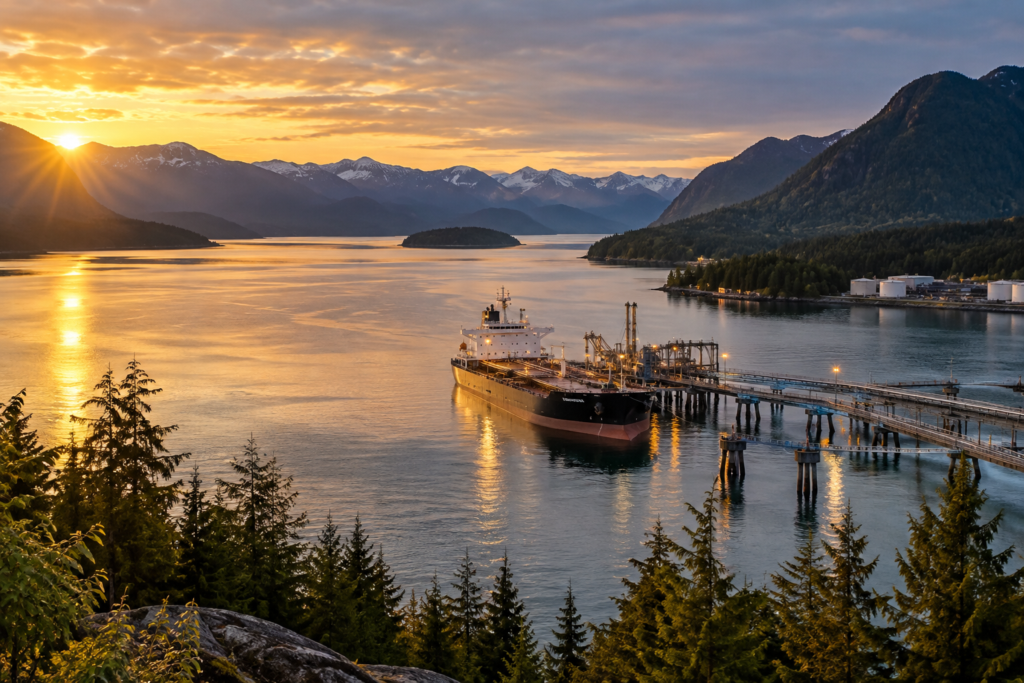
Canada still relies almost entirely on a single corridor through Metro Vancouver for its non-U.S. crude exports. The expanded Trans Mountain pipeline (TMX), even optimized to roughly 1.2 million barrels per day, channels the nation’s most valuable commodity through a region where Natural Resources Canada gives a 30 percent chance of a significant earthquake within the next 50 years.
The Lower Mainland sits on deep, saturated basin sediments that are prone to liquefaction; a corridor built across them is prone to catastrophic disruption. Dredging Burrard Inlet for larger tankers does not change this reality. Nor does the proposed terminus of the new line at Roberts Bank, south of Vancouver, which sits on the Fraser River delta.
Expanding west-coast egress is good. Relying solely on the Lower Mainland is foolish.
Canada needs geographic redundancy.
Prince Rupert, B.C., offers a deep-water port with real economic, environmental and logistical advantages for trans-Pacific energy trade. It is not a replacement for TMX — it is the strategic complement Canada lacks.
Prince Rupert is the closest major North American port to Northeast Asia. By the port authority’s reckoning, a tanker bound for Shanghai sails about 36 hours less from Prince Rupert than from Vancouver. Shorter voyages lower bunker fuel consumption, crew costs and emissions while improving vessel turnaround and supply reliability. For Canadian producers competing in Asian markets, those advantages matter.
The economics reinforce the resilience case. For Asian refiners, a shorter voyage means lower transportation costs and less inventory tied up in transit. For Canadian producers, it improves netbacks and makes barrels more competitive in markets where freight and carbon intensity increasingly affect sourcing decisions. Geographic diversification would therefore do more than insure against disruption: it would create a second export corridor with its own commercial advantages.
Prince Rupert also has natural maritime advantages. Unlike Burrard Inlet — a narrow, urbanized waterway requiring tug escorts, speed restrictions and complex navigational protocols — Prince Rupert opens directly onto the North Pacific. Tankers reach deep water quickly, avoiding many of the bottlenecks and ecological choke points that characterize southern shipping.
None of this requires pretending northern British Columbia is seismically quiet. The Queen Charlotte Fault, offshore from Haida Gwaii, produced Canada’s two largest recorded earthquakes: magnitude 8.1 in 1949 and magnitude 7.8 in 2012. The northern coast faces real seismic hazards, but they are different hazards. They do not sit beneath deep, liquefiable basin sediments or a major metropolitan area with fragile infrastructure.
A northern route does not eliminate seismic exposure; it diversifies it. That is my argument, and it is why redundancy should be treated as national infrastructure policy rather than an optional enhancement.
Recent events make the point difficult to dismiss. The magnitude 7.1 earthquake that struck Kumamoto, in southern Japan, on July 28 killed dozens, damaged roads and utilities, and halted automobile and semiconductor production, despite decades of investment in earthquake preparedness. Then, on August 10, a magnitude 7.4 earthquake struck western Colombia, killing hundreds and damaging buildings and infrastructure.
Neither event proves an earthquake in British Columbia is imminent. Both are evidence that major seismic disruptions are real, recurring risks. Critical national infrastructure should be designed accordingly: not around the assumption that disaster can be engineered away, but around resilience when it occurs. A second Pacific gateway would ensure that no single regional event can sever Canada’s principal export route to Asia.
Any serious discussion of northern access must also address the Oil Tanker Moratorium Act, the former Bill C-48. The Act bars tankers carrying more than 12,500 tonnes of crude or persistent oil from loading at any port on the north coast, from the Alaska border to the northern tip of Vancouver Island, a stretch that includes both Prince Rupert and Kitimat. Ottawa announced the moratorium legislation in November 2016 on the same day it rejected Northern Gateway; the Act followed in 2019 and forecloses any revival of that route. The July announcement reaffirmed it: the new pipeline, Ottawa said, will “fully respect” the moratorium even as west-coast pipeline development advances.
This policy reality cannot be ignored. But it can be debated.
The moratorium was designed for a different era — before TMX was complete and before energy security returned so forcefully to the geopolitical agenda. It closes off deep-water ports that offer Canada significant strategic advantages in Asian trade. If Canada wishes to diversify its energy corridors, reduce its dependence on a single seismic choke point and strengthen its position in Asian markets, it must revisit the moratorium. That could mean amending it, replacing it with a modern regulatory framework, or identifying northern destinations outside the restricted zone.
If British Columbia and the federal government remain unwilling to consider a northern alternative, Canada must acknowledge another geographic reality: Alaska is not bound by C-48. Ports such as Ketchikan sit just north of the moratorium boundary and offer deep-water access under a U.S. government supportive of expanded oil and gas infrastructure.
It is not a threat — it is a fact. If Canada chooses not to diversify its own corridors, others may step into the role.
The central point is simple. Expanding west-coast egress is positive, but concentrating it entirely in the Lower Mainland is strategically reckless. Prince Rupert offers a geographically distinct, economically attractive and environmentally advantageous second gateway. It does not replace TMX. It complements it.
Infrastructure resilience is not achieved by predicting which fault will move next. It is achieved by ensuring that when disruption comes — geological, economic or geopolitical — the country has another route. For an export economy as dependent on energy as Canada, redundancy is not duplication. It is risk management.