

Two neighbours share the same difficult customer. Both depend on the American market for the overwhelming share of their exports. Both are governed by left-wing parties that spent the past decade weakening the economies they must now defend. Both have absorbed a stream of public insults from the same White House.
Only one of them still has its market access largely intact. Why?
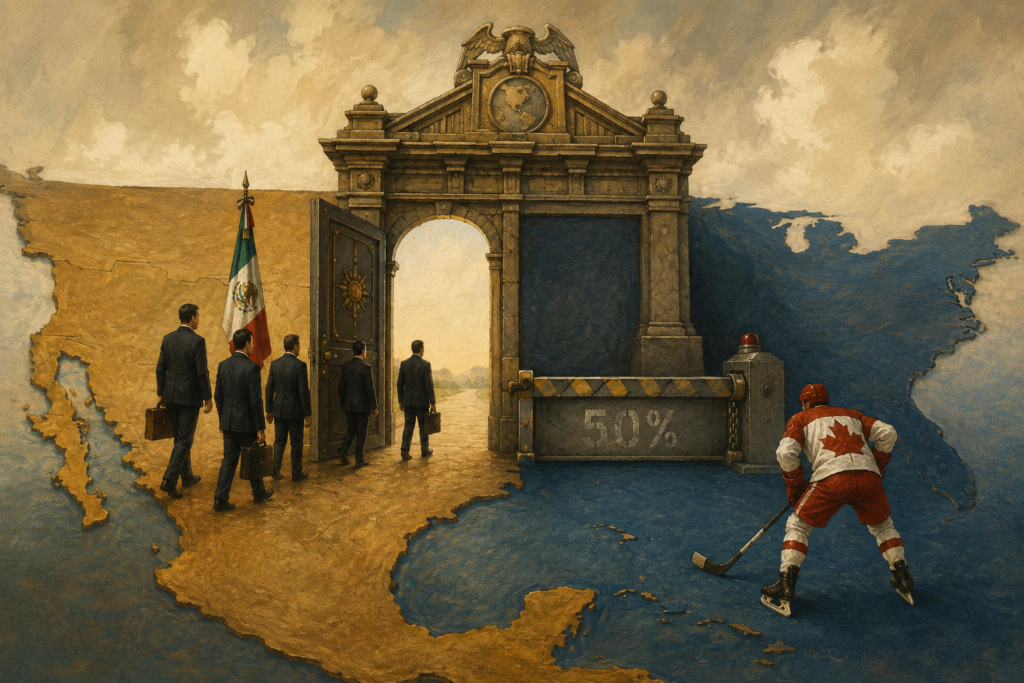
Start with the insults because Mexico received, arguably, the worst of them. Trump has told the world that “the cartels are running Mexico,” essentially hinting that the presidenta is a narcopuppet. He has said Claudia Sheinbaum is “so afraid of the cartels she can’t even think straight.” He renamed the Gulf of Mexico the Gulf of America by executive order. He designated the cartels foreign terrorist organizations and, in the same January interview that produced the narcopuppet line, promised to start “hitting land” against them on Mexican soil. He revived the wall, the caravans, and the criminality theme he has worked since 2015.
Canada, by comparison, received taunts of the fifty-first state and a running commentary on its prime ministers. Wounding, perhaps. Crude, far less so.
Now compare the results. Mexico concluded its third round of bilateral negotiations with Washington in Mexico City in late July, with working tables on steel, aluminum, automobiles, economic security, labour, agriculture, and electronic payments; a fourth round is already set for September. Roughly 85 per cent of Mexican exports still enter the United States tariff-free, a figure Marcelo Ebrard repeats like the announcement to the mysteries in a rosary asking for the associated grace.
Not much grace for the Northerners, alas. Canada has yet to begin formal negotiations; its minister makes phone calls. Instead, on August 19, Canada becomes the first target of Section 338 of the Tariff Act of 1930 in the statute’s near-century on the books: a 50 per cent duty on roughly US$20 billion in dairy, alcohol, and several hundred other tariff lines, with no expiry date and no relief for CUSMA-origin goods.
The country that swallowed the crudest insults kept the market. The country that performed its outrage got the tariff.
Payment in the right currency
Calm was one half of the Mexican method. Payment was the other. Presidenta Sheinbaum sent ten thousand National Guard troops to the northern border in February 2025. That same month, her government delivered twenty-nine imprisoned cartel figures to American justice in a single night, Rafael Caro Quintero among them, using a national security provision to bypass the formal extradition process (I have written about the extradition process here in my Civitatensis Substack). Twenty-six more followed in August. She accepted deportation flights and raised tariffs on non-free-trade partners, walling off Chinese vehicles and transshipment, instead of travelling to China to bow before the Beijing leader, aligning Mexico with Washington’s larger quarrel.
A critic will call this capitulation. The critic misses the intended design. Mexico’s leadership identified what the customer wanted and paid in its cheapest available currency: security cooperation it largely wished to pursue anyway, against cartels that murder Mexicans first and Americans second.
Canada paid in its most expensive currency, taxing its own consumers through counter-tariffs, then handed over its actual concessions free of charge: the digital services tax died in a weekend, most counter-tariffs quietly came off last September, and Washington still counts none of it toward the files it cares about, autos, dairy, and alcohol. One country transacted. The other performed, then paid anyway.
The similarity that sharpens the contrast
Ideology explains none of this. Sheinbaum leads Morena, a left-wing movement allied with Havana and heir to López Obrador’s statism. Her government has loaded PEMEX with debt that keeps it among the most indebted oil companies on earth even after recent paydowns, subjected the judiciary to popular election, and dismantled autonomous regulators, while the federal deficit widened to its broadest since the 1980s and the debt ratio climbed by a quarter. Mexican growth slowed to 0.6 per cent last year and remains weak under the weight, resting on productivity that has barely moved in a generation. She is no Trumpian natural ally.
Canada’s Liberals, for their part, presided over what RBC calls the largest capital exodus in Canadian history, more than one trillion dollars of investment leaving the country between 2015 and 2024, two dollars exiting for every dollar of foreign investment coming in. They more than doubled the federal debt, let productivity decay until the Bank of Canada called it an emergency, ran the merchandise trade deficit to $31.3 billion in 2025, the largest since 2020, and watched Canada lose its place as the top destination for American exports after more than three decades on top. Mexico took the spot.
Two committed left-wing governments, then, each of which weakened its own hand before the game began. The difference lies elsewhere.
The incentive to perform
Sheinbaum does not need anti-Americanism. Her approval ratings sit near seventy per cent (68 per cent in El Financiero’s June national poll), her coalition dominates Congress with a formal supermajority in the lower house, and her voters’ households are bound to the American economy through remittances, family, and factory work.
Mexico possesses the richest inventory of anti-American grievance in the hemisphere, running from 1848 to the present, and its president leaves the inventory in the warehouse. She corrects Trump at her daily morning press conference (the mañanera), perennially invokes sovereignty, and sends Ebrard to Washington the same week. Ebrard himself describes the posture as “modo zen” (zen mode). The style is deliberate. Restraint costs her nothing politically and buys her everything commercially.
Prime Minister Carney faces the opposite arithmetic. His government owes its existence to the anti-Trump program his party started and his state broadcaster promotes daily. The 2025 election was fought and won on elbows up, and a mandate built on confrontation must be serviced with confrontation. Hence the 25 per cent counter-tariffs on American automobiles. Hence the provincial liquor boards sweeping American bourbon from their shelves to applause. The performances played well at home. They also played in Washington, where the administration cited Canada’s auto tariffs, the liquor purges, and cheese quota administration as the three legal predicates for Section 338. Two of the three are artifacts of Canada’s own internal protectionism. Our provincial liquor monopolies and our supply-managed dairy regime, defended for decades as untouchable, have now handed a foreign power the justification for a tariff wall. Laurentian and Atlantic Canadians are so thinly-skinned anti-American.
Mr. Carney sold himself to Canadians as the man who manages economies and manages crises like no other. He told voters he had steered central banks through the crash of 2008 and through Brexit, and that a moment of rupture called for exactly his kind of talent. A year and a half into his tenure, the economy carries its largest trade deficit since 2020 and the crisis has acquired a start date: August 19, at one minute past midnight. Perhaps he will astonish us all and pull a rabbit from the hat at the last minute. The hat, however, has so far mostly produced the bill.
Juan Carlos Baker, a former senior Mexican trade negotiator, put the asymmetry in a single sentence for Reuters: Sheinbaum “has more degrees of freedom to operate than Prime Minister Carney does.” Her freedom flows from a mandate that never depended on fighting Trump. His constraint flows from a mandate he chose to craft that depends on little else.
A front that cannot hold at home
Coherence is the other missing ingredient because a common front abroad presupposes a common front within Canada, and the federation cannot manage one. Last October, Ontario spent seventy-five million dollars airing an anti-tariff advertisement built from Ronald Reagan’s 1987 radio address on free trade. Trump terminated all trade talks within hours of the Reagan Foundation’s complaint. Premier Ford promised to pull the ad, then let it run during the first two games of the World Series anyway, and Washington added 10 per cent to every existing tariff on Canadian goods two days later. One province freelanced a trade war. The federation paid the invoice (How many police officers would $75 million buy in Ontario?).
The federal pattern runs quieter and cuts deeper. In June of last year, Trump cut off negotiations over Canada’s digital services tax, a levy Ottawa had defended for months as settled law. Within forty-eight hours, the government rescinded the tax outright, on the eve of first collection, and received nothing in return beyond resuming talks. Theatrical resistance followed by uncompensated surrender is worse than either pure defiance or pure accommodation because it destroys the one asset a smaller negotiating partner owns: predictability. Ebrard’s flat, repetitive calm preserves exactly that asset. Ottawa has burned it twice in nine months.
One government in Canada, coincidentally also headed by a woman, did behave like Mexico, and it sits in Edmonton. Alberta paused American liquor purchases in March 2025, thought better of the silly gesture, and by June 6 became the first province, alongside Saskatchewan, to restore them, with the responsible minister framing the reversal as setting the stage for constructive CUSMA negotiations.
When the 50 per cent threat landed this month, Premier Smith declined to repeat the theatre, telling Albertans the approach “has got to be measured” and that “we’ve got to be calm about it” while the province works the sectoral files one by one.
Carney pulled the other way, suggesting the provinces keep American alcohol off their shelves until a broader agreement arrives, preserving as bargaining leverage the very practice Washington cites as a predicate for the wall. Ontario and Quebec keep American alcohol off their shelves, and Washington still cites the fact among its predicates for the tariff wall. The province that behaved like level-headed Mexico is Alberta.
The common front that commits to nothing
What about the counterweight? Ottawa and Mexico City announced a comprehensive strategic partnership and a three-year Action Plan last September. Trade missions crossed in both directions through the winter and spring. In June, Sheinbaum declared that Mexico and Canada had formed a common front. In July, Mexico’s foreign secretary stood beside Anita Anand in Ottawa and promised his country would never abandon the trilateral pact, while Anand announced $12 million for projects on identity management, human trafficking, and illegal fishing.
Measure the front against the ledger. Canada sells Mexico $8.9 billion a year and buys $53.4 billion, a merchandise deficit approaching $45 billion, roughly the size of New Brunswick’s entire economy. The tangible fruit of the partnership to date consists of eased Mexican import rules for Eastern Canadian apples, electronic certificates for canola and wheat, and a new certificate for Canadian pet food. Apples and pet food do not counterweight a superpower on any side of this galaxy.
And when Reuters asked both governments about coordinating their bilateral tracks with Washington, Canada’s trade minister’s office protested its readiness at length. Mexico’s Economy Ministry prudently declined to comment.
Silence is often a wise position. Mexico will not spend a single peso of leverage defending a partner who barely trades with it, and Sheinbaum’s solidarity costs her nothing precisely because it commits her to nothing. The common front is insulation manufactured for Canadian domestic consumption. The Mexicans know it. Canadians seem to pretend not to.
The objection worth answering
A fair-minded critic will raise one more point. Mexico, the critic will say, had no choice: with more than eighty per cent of its exports bound for one market, restraint was compulsion dressed as wisdom, while Canada could afford a measure of defiance.
The objection inverts its own logic, however. Restraint under greater duress demands more discipline, since Sheinbaum absorbs insults she has less power to answer. Nor does the ledger excuse Canada. Both governments damaged their own economies, yet Mexico negotiates like a country that knows it is weakened, while Canada postures like a country that still believes its own press. Defiance without capacity is just performance. Carney is a fitting heir to Justin Trudeau.
What restraint would look like
None of this argues for capitulation, and the Mexican file shows the difference between restraint and surrender in practice. A serious Canadian strategy would drop the performances, identify the currencies Washington values, and pay in the cheapest of them: continental defence, Arctic security, critical minerals, alignment on China.
Each costs Canada little that Canada does not already need to do for itself. The strategy would then dismantle the internal protectionism that armed Section 338, since the liquor monopolies and the dairy regime injure Canadian consumers first and supply foreign tariff predicates second. Ottawa controls the dairy regime and the federal levers; the liquor boards belong to the provinces, which means the strategy demands a federal-provincial discipline the past year has not produced. The obstacle is a mandate that rewards elbows.
The bigger difference remains self-knowledge. Mexico knows exactly what it is: a dependent exporter that cannot afford oversized pride at the border. It sends more than eighty per cent of its exports to one customer and negotiates accordingly, with a cool head and a long memory. Canada sends 71.7 per cent of its exports to the same customer while telling itself stories about being superior, a major trading nation. The stories no longer survive the arithmetic. Canada accounts for roughly 2.2 per cent of world merchandise exports and now ranks below Mexico. Yup, the gaslighting is coming from inside the house.
The mature nationalist swallows the insult and keeps the market for the sake of stability and its people. The performing nationalist returns the insult and loses it.