

World News Day celebrates journalism: Mexican reporters face murder and intimidation while Canada debates a press dependent on public moneyMexican reporters face murder and intimidation while Canada debates a press dependent on public money.
Today (September 28), more than a thousand newsrooms in over a hundred countries marked World News Day, a campaign the Canadian Journalism Foundation founded in 2018 and has since run each September 28 to coincide with UNESCO’s International Day for Universal Access to Information. This year’s slogan asks readers to know the facts, understand what matters, and choose trusted journalism. The sentence presumes two things: journalists willing to do the work, and a craft healthy enough to be worth the risk. Nine hundred kilometres south of the Rio Grande, one of those two is disappearing. In Canada, it is the other.
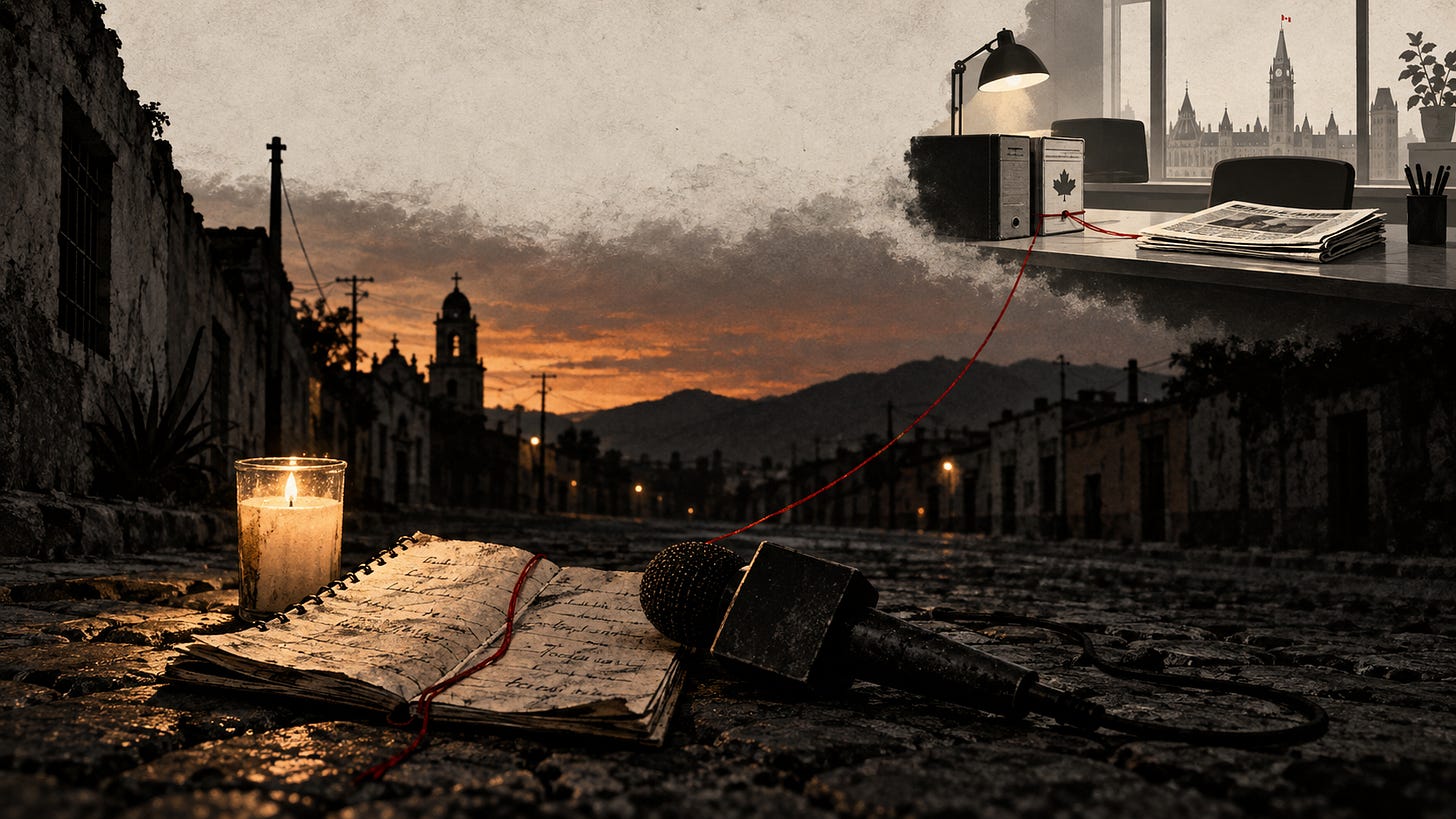
Mexico is not losing its journalism. It is losing its journalists, one at a time, to bullets, while the profession they practised keeps asking the same questions that got them killed. Canada is not losing its journalists. It is losing its journalism, one compliant silence at a time, while its reporters go home safely every night to a trade that no longer quite earns the name.
The body count
Article 19, the organization that has tracked killings of Mexican journalists since 2000, counts 48 murdered during Felipe Calderón’s presidency (2006–2012) and 47 during Enrique Peña Nieto’s (2012–2018). Andrés Manuel López Obrador, who took office promising an end to the drug war’s toll on Mexican life, matched Peña Nieto’s number exactly: 47 Mexican journalists killed for their work between December 2018 and September 2024, by Article 19’s own count.
Reporters Without Borders, applying a narrower test for confirmed motive, puts the figure lower, at 37 killed and five disappeared through April 2024, but even that count leaves Mexico atop the hemisphere’s death list for the trade. A Human Rights Center report from the University of California, Berkeley, published this September and combining journalists with murdered human rights defenders, found the toll of López Obrador’s six years closer to 337 dead in total, 78 of them journalists, with impunity running between 93 and 99 percent across the period.
Violence short of murder rose faster still. Article 19 recorded 3,408 aggressions against the press during López Obrador’s term, against 2,502 under Peña Nieto, an increase of 62 percent, and found that the single largest source of those aggressions was not organized crime. It was the Mexican state itself, responsible for nearly 46 percent of documented cases, most of them committed by civil officials rather than police or soldiers.
Both López Obrador and Sheinbaum built their security doctrine on the same premise that hugs, not bullets, would starve the cartels of the confrontation they wanted. Abrazos, no balazos. Whatever its merits as a counter-narcotic strategy, that doctrine has coexisted for eight years with a murder rate against journalists that never dipped below the level set by the two presidents who preceded it and who never claimed to be running anything but a war. A policy sold as an alternative to violence has produced, for the press specifically, no measurable reduction in it.
Claudia Sheinbaum inherited this record and has not broken from it. Twenty-nine days into her term, on October 29, 2024, Mauricio Cruz Solís, a twenty-five-year-old radio director in Uruapan, Michoacán, was shot dead minutes after finishing a live broadcast and interviewing the city’s mayor, Carlos Manzo, who would himself be assassinated a year later. It was the third killing of a journalist under Governor Alfredo Ramírez Bedolla and the first of Sheinbaum’s own government. Reporters Without Borders called it symbolic of the challenge awaiting a president who had just taken office. It has not been resolved.
By one count reported in July 2026, nineteen journalists have been killed since Sheinbaum’s inauguration. The Press Emblem Campaign, a Geneva-based press-freedom organization, ranked Mexico the third deadliest country in the world for journalists in 2025, behind only Gaza and Yemen, despite having no armed conflict of its own. Mexican journalists have not gone quiet in response. Colleagues of the dead erected an antimonumento in Mexico City this year to demand justice, the kind of organized, public defiance a frightened profession does not attempt.
The Committee to Protect Journalists documented a further acceleration within that toll in 2026 specifically: six journalists murdered by August of that year, five of them within little more than two months, one of the deadliest spikes CPJ says it has recorded in over a decade. Three of the 2026 killings occurred in Veracruz, whose governor, Rocío Nahle, told reporters in June that her state has no problem with violence against the press.
Sheinbaum has not commented on the broader pattern, and her government has not announced any response. CPJ’s Mexico representative, Jan-Albert Hootsen, put the choice bluntly: Sheinbaum can break the cycle of violence and impunity that defined her predecessors, he said, or she can become the next in a long line of Mexican presidents who stood by while the country cemented its standing as the deadliest place in the Americas to be a reporter. So far, for all the talk about transformation, it remains the latter.
Chayote, openly
What Sheinbaum has commented on, at length and without prompting, is money. On August 4, at her morning press conference, the mañanera, she attributed the criticism her government receives to journalists who no longer collect chayote, the long-standing Mexican slang for the payments once used to buy favourable coverage. Asked which outlets go without official advertising, she did not equivocate. TV Azteca does not receive it, she said proudly, nor Reforma, nor El Universal. Abiertamente lo digo. I say it openly.
The admission sits poorly against her own government’s rules. The guidelines governing official advertising, published under López Obrador in January 2021, require public communication budgets to be distributed according to objective, impartial, and transparent criteria that guarantee equal opportunity among outlets. A president who tells the country, in the same breath, that critics have lost their chayote and that three of the country’s most prominent and most critical newspapers receive no advertising money at all has not broken that rule by accident. She has described the breach as a policy.
Sheinbaum’s List
Ten days later the pattern sharpened. On August 14, presidential legal counsel Luisa María Alcalde used the mañanera’s “Derecho de Réplica” segment to present what her office called an analysis of a digital amplification ecosystem, built from tracking 98 seed accounts between January 1 and August 8, 2026. The first of its four layers, Alcalde explained, consisted of 54 accounts belonging to journalists, outlets, and commentators she accused of originating content critical of the government. Among the names doxed from the National Palace was Carmen Aristegui, one of Mexico’s most respected investigative journalists. Article 19 subsequently documented a rise in threats and intimidation against the people named on live television. Quelle surprise.
Sheinbaum’s defence followed a familiar shape, one AMLO had already rehearsed when he read a New York Times correspondent’s personal phone number into his own morning conference in February 2024. It was not a list, Sheinbaum insisted, merely an illustration of how amplification works on social media; certainly, no one had been censored. She mocked the journalists who said, with evident pride, that they were glad to have made it. Days later, as criticism failed to subside, she allowed that perhaps the names should not be read out again, while making plain that the underlying monitoring would continue.
The irony needs no outside supply. In October 2021, as mayor of Mexico City, Sheinbaum recorded a video denouncing this exact practice. ¿Quién hace listas? she asked. El macartismo, el nazismo, ellos son los que hacían listas. Who makes lists? McCarthyism does. Nazism does. Those are the ones who made lists. She posted it under the hashtag #QueMeAnotenEnLaLista, put me on the list.
Five years later, her own presidency read a list of fifty-four names into a live broadcast and insisted it was something else.
What “attacked” means, and where
None of this will surprise anyone who has read the last two decades of Mexican press coverage. What deserves saying plainly, on a day built to praise journalism, is how far the word attacked has travelled from its Mexican meaning by the time it reaches Canadian newsrooms.
Canada spends over $1.8 billion a year keeping its press afloat, through payroll tax credits, direct appropriations to the public broadcaster, and a law compelling Google to pay outlets it does not employ. No Canadian reporter has been shot for a story about a mayor’s contracts. No Canadian official has read a journalist’s home address into a live broadcast, though Ottawa has restricted departmental press access according to which outlets qualify for its subsidy, and the current prime minister hides from Canada’s press while conceding interviews to foreign outlets, which is its own quiet cousin of the same instinct that produced Sheinbaum’s advertising boast.
The Mexican and Canadian versions of state leverage over the press share a structure, reward what flatters and starve what does not, even as they differ by an order of magnitude in what starving means.
That difference is precisely the point being lost. When a subsidized Canadian journalist calls a hostile question, a bad poll on media trust, or an unflattering column an attack, the word has drifted very far indeed from what it still means this week in Michoacán, in Veracruz, in Oaxaca, where it means a body in a car and a case that will not be solved.
A subsidy that compromises editorial independence is a real problem for a democracy, and a few Canadians, not very many, are right to argue about it, loudly and often. A bullet is a different order of problem entirely, and a government that boasts about which newspapers it starves of advertising, then denies keeping a list while reading names from one, is not having the same argument as a country debating how many hundred million dollars its public broadcaster should receive next year.
Both arguments matter.
Neither should borrow the other’s vocabulary. World News Day’s celebratory tone, built for newsrooms secure enough to celebrate, tends to flatten the difference between losing your journalists and losing your journalism. Today, the day a Canadian foundation invented to defend journalism everywhere, is a fitting occasion to stop flattening it, and to say without qualification which of the two conditions kills what.
Journalists who are killed are, as a rule, journalists who could not be bought or frightened into silence. The slain defend their craft with their lives, and the word inspiration is earned, not given. Those who take money do not need to be harmed; they do the harm themselves, to the profession they claim to serve. Mexico’s conscientious journalists work under constant mortal threat, and their craft survives it more or less intact. Canadian journalists thankfully face no comparable danger, but their craft is dying anyway, a little at a time, wherever a news outlet takes Ottawa’s money and undermines its credibility.